


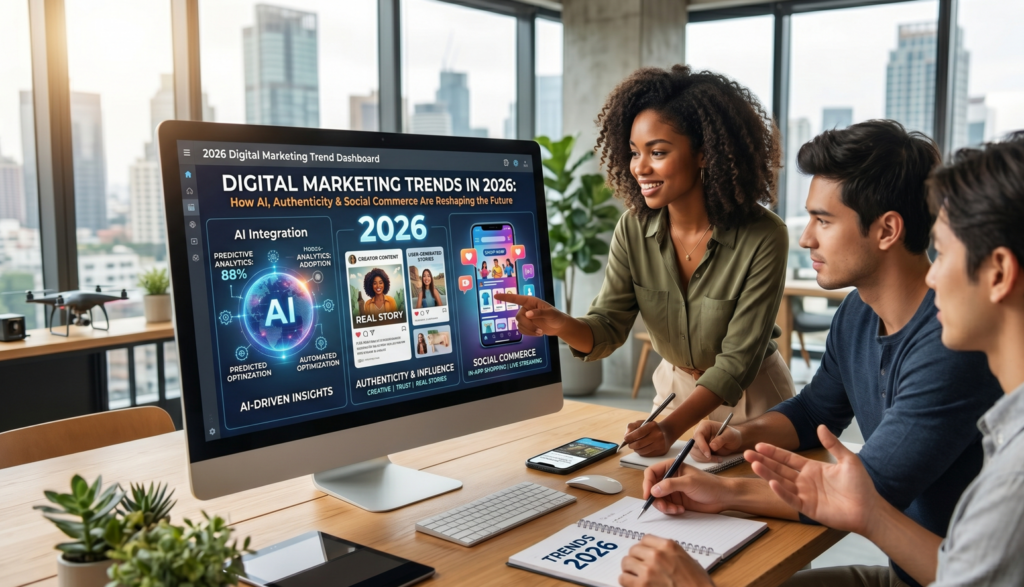
The digital marketing landscape is evolving faster than ever before. In 2026, businesses are no longer experimenting with artificial intelligence — they are building entire marketing ecosystems around it. At the same time, consumers are demanding something technology alone cannot deliver: authenticity, trust, and human connection.
- Agentic AI Is Transforming Digital Marketing
Artificial Intelligence has moved beyond content generation. The newest evolution is Agentic AI — intelligent systems capable of managing, optimizing, and automating complete marketing workflows with minimal human intervention.
From campaign optimization and customer segmentation to automated email journeys and predictive analytics, AI agents are helping brands operate smarter and faster.
According to industry reports:
- Nearly 49% of marketers now use AI to create personalized content at scale.
- 91% of AI adopters report improved customer engagement.
- 93% of CMOs using generative AI say it delivers measurable ROI.
This shift is enabling brands to deliver highly targeted experiences across every stage of the customer journey.
Why It Matters
Businesses that adopt AI strategically can:
- Improve campaign performance
- Reduce operational costs
- Personalize marketing at scale
- Increase customer retention
- Generate faster business insights
- Hyper-Personalization Is the New Standard
Modern consumers expect brands to understand their preferences, interests, and behaviors. Generic advertising no longer works.
In 2026, hyper-personalization is becoming the foundation of successful digital marketing strategies. AI tools now analyze customer behavior in real time to deliver:
- Personalized product recommendations
- Dynamic website experiences
- Customized email campaigns
- Predictive customer support
- Targeted social media ads
Consumers are more likely to engage with brands that make interactions feel personal and relevant.
The Future of Customer Experience
Brands that leverage first-party and zero-party data responsibly will build stronger customer trust and long-term loyalty.
- Authenticity Is More Powerful Than Volume
As AI-generated content floods the internet, audiences are becoming increasingly selective about the brands they trust.
The biggest shift in 2026 is clear:
Value-driven marketing is replacing volume-driven marketing.
Consumers are no longer impressed by constant posting. Instead, they prefer:
- Authentic storytelling
- Transparent communication
- Brand purpose
- Community engagement
- Educational and meaningful content
Research shows that:
- 56% of marketers believe the internet is saturated with AI-generated content.
- 82% of consumers prefer buying from brands that align with their values.
What Brands Should Focus On
Businesses should prioritize:
- Human-centered branding
- Customer trust
- Community building
- High-quality content
- Real customer experiences
This is where strong branding and strategic content marketing become essential.
- Short-Form Video Dominates Consumer Attention
Short-form video continues to lead digital engagement across all platforms.
Platforms like:
- TikTok
- Instagram Reels
- YouTube Shorts
are now the most effective channels for brand storytelling and audience engagement.
Why Short-Form Video Works
Short-form videos are:
- Easy to consume
- Highly shareable
- Algorithm-friendly
- Perfect for mobile users
- Effective for brand awareness
Businesses investing in creative video marketing are seeing higher reach, stronger engagement, and better conversion rates.
Best Short-Form Video Content Ideas
- Behind-the-scenes videos
- Product demos
- Customer testimonials
- Educational tips
- Quick tutorials
- Trend-based content
- Social Search Is Replacing Traditional Search Engines
One of the biggest SEO disruptions in recent years is the rise of social search.
Today’s consumers — especially Gen Z — increasingly search for:
- Product reviews
- Restaurants
- Travel ideas
- Fashion inspiration
- Service recommendations
directly on platforms like:
- TikTok
- YouTube
instead of traditional search engines.
What This Means for SEO
Businesses now need to optimize:
- Social media captions
- Hashtags
- Video descriptions
- On-screen text
- User engagement signals
This trend is reshaping how brands approach content discovery and organic visibility.
- Social Commerce Is Becoming the New E-Commerce
Social media is no longer just for engagement it’s becoming a full-scale shopping ecosystem.
Consumers increasingly purchase products directly through social platforms without ever visiting a traditional website.
The Rise of Social Commerce
Features like:
- In-app shopping
- Live commerce
- Product tagging
- Influencer collaborations
- Shoppable videos
are driving a major transformation in online buying behavior.
Industry experts predict that social commerce will continue growing rapidly throughout 2026 and beyond.
Why Businesses Must Adapt
Brands that integrate social commerce strategies can:
- Shorten the customer journey
- Increase impulse purchases
- Improve conversion rates
- Boost mobile shopping experiences
- The Future Is Privacy-First Marketing
With the decline of third-party cookies, marketers are entering a new era focused on ethical data collection and consumer privacy.
Businesses now rely more heavily on:
- First-party data
- Zero-party data
- AI-driven insights
- Consent-based personalization
Building Trust Through Transparency
Consumers expect brands to:
- Protect their data
- Be transparent about tracking
- Deliver relevant experiences without being intrusive
Privacy-first marketing is no longer optional — it’s essential for long-term brand credibility.
The future of marketing is not about choosing between AI and human creativity — it’s about combining both strategically.
The brands winning in 2026 are those that can:
- Use AI to improve efficiency
- Deliver personalized customer experiences
- Create authentic and value-driven content
- Build communities instead of just audiences
- Adapt quickly to evolving consumer behavior
Technology alone cannot build trust. Human connection remains the foundation of successful branding.
Usefull