



Social Media Content Strategy: How to Balance Value, Engagement & Promotion
Social media has become one of the most powerful channels for businesses to build brand awareness, connect with customers, generate leads, and drive sales. But there is one common mistake many businesses make: they treat social media like a digital billboard.
Every post talks about the company’s products, services, offers, discounts, or achievements.
The result?
People stop paying attention.
A well-planned Social Media Marketing strategy can help businesses build brand awareness, engage their target audience, generate leads, and support long-term business growth.
This is where the 70-20-10 content rule can provide a simple and practical framework.
The idea is straightforward:
Content Type | Recommended Share | Primary Purpose |
Value-Driven Content | 70% | Educate, inform, and help your audience |
Community/Engagement Content | 20% | Build relationships and encourage interaction |
Promotional Content | 10% | Promote products, services and offers |
The 70-20-10 rule is not a rigid algorithm or a guaranteed formula for social media success. Instead, it is a content planning framework that helps businesses avoid becoming overly promotional while maintaining a healthy mix of useful, engaging, and conversion-focused content.
In this guide, we will explain how the 70-20-10 content rule works, why it matters, what you should post in each category, and how businesses can use it to build a practical social media content strategy.
What Is the 70-20-10 Content Rule?
The 70-20-10 content rule divides your social media content into three major categories.
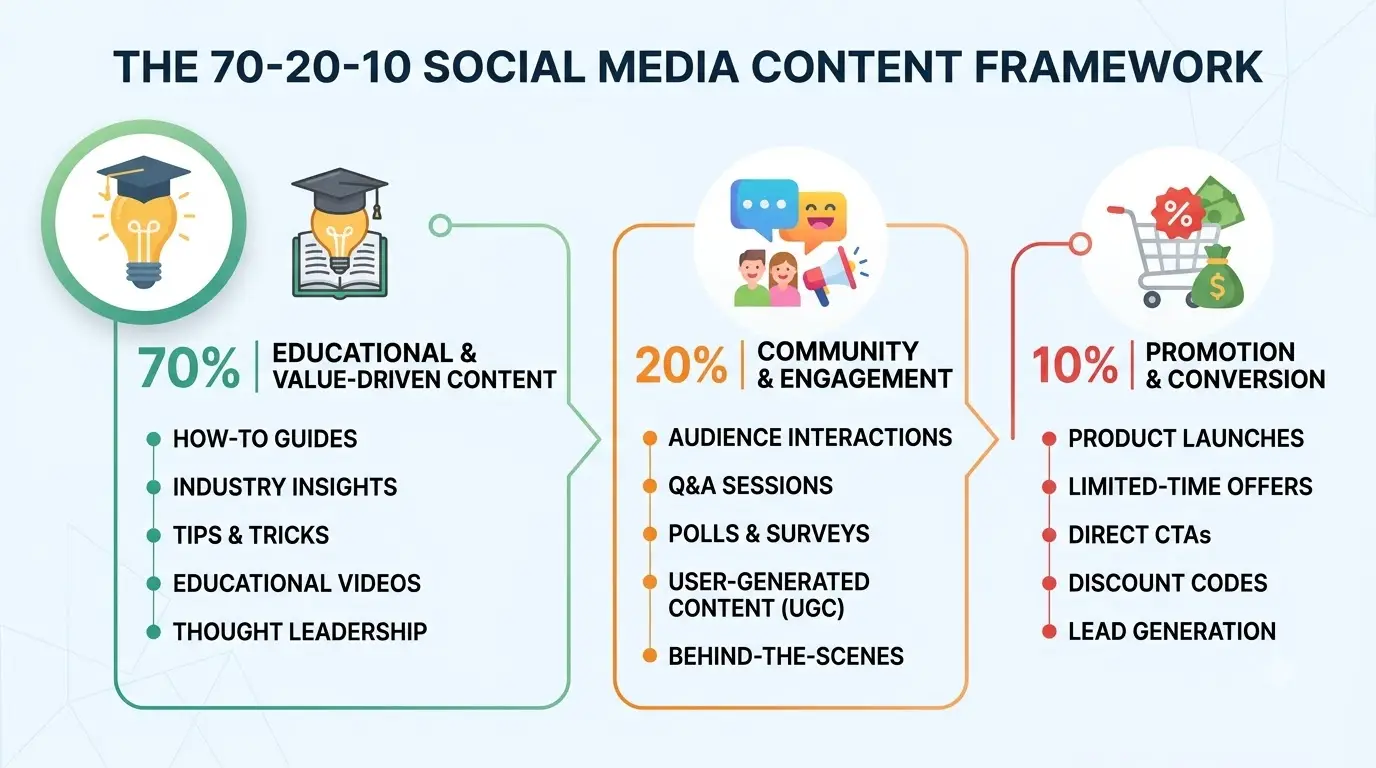
70% — Value-Driven Content
Around 70% of your content should provide genuine value to your target audience.
This content should answer questions, solve problems, educate customers, provide useful insights, or help people make better decisions.
Examples include:
- Educational posts
- How-to guides
- Industry tips
- Tutorials
- Checklists
- Infographics
- Frequently asked questions
- Industry trends
- Mistakes to avoid
- Case studies
- Expert insights
- Statistics and research
- Short educational videos
- Blog content
The purpose is not to immediately sell.
The purpose is to make your audience think:
“This brand actually understands my problem.”
20% — Community & Engagement Content
The next 20% should focus on building relationships with your audience.
Social media is designed to be social. Therefore, businesses should create opportunities for people to interact with the brand rather than simply consume promotional messages.
Examples include:
- Polls
- Questions
- Quizzes
- Behind-the-scenes content
- Employee stories
- Customer stories
- User-generated content
- Industry discussions
- Testimonials
- Celebrations
- Interactive reels
- “This or That” posts
- Community shout-outs
The objective is to encourage conversation and make the brand feel more human.
10% — Promotional Content
The remaining 10% can be directly promotional.
This is where you talk about:
- Products
- Services
- Offers
- Discounts
- New launches
- Free consultations
- Webinars
- Events
- Lead-generation campaigns
- Product demonstrations
- Service benefits
- Calls to action
Promotional content is important because businesses ultimately need conversions.
However, when promotional content dominates the content calendar, audiences can quickly experience content fatigue.
The 70-20-10 framework creates a healthier balance.
The 70%: Create Content That Educates and Helps
The largest part of your social media strategy should focus on your audience’s needs. Creating educational, informative and problem-solving content is an important part of a strong digital marketing strategy, helping businesses provide consistent value while building authority in their industry.
Before creating a post, ask:
“What will the audience gain from this content?”
If the answer is knowledge, clarity, inspiration, entertainment, or a solution to a problem, you are probably creating value-driven content.
1. Educational Content
Educational content positions your business as a knowledgeable resource.
For example, a digital marketing agency could publish:
- How SEO helps small businesses
- 5 common social media mistakes
- How to create a content calendar
- SEO vs PPC: What’s the difference?
- How to improve website conversion rates
- How businesses can use AI in marketing
Educational content can also be repurposed into multiple formats.
One blog post can become:
- An Instagram carousel
- A LinkedIn post
- A short-form video
- An infographic
- A Twitter/X thread
- An email newsletter
This makes content creation more efficient.
2. How-To Content?
People frequently use search engines and social media to learn how to accomplish something.
Therefore, “how-to” content can be highly useful.
Examples:
How to Create a Social Media Content Calendar?
How to Improve Instagram Engagement?
How to Choose the Right Digital Marketing Channel?
How to Write SEO-Friendly Website Content?
How to Generate Better Leads Through Social Media?
The key is to provide practical information rather than generic advice.
3. Industry Insights and Trends
Your audience wants to understand what is changing in their industry.
Businesses can create content around:
- New technologies
- Consumer behavior
- Marketing trends
- Platform updates
- Industry statistics
- Emerging opportunities
- Common challenges
However, avoid creating content simply because a topic is trending.
The topic should be relevant to your audience and your business expertise.
4. Problem-Solving Content
One of the strongest forms of value-driven content is content that solves a specific problem.
Instead of saying:
“We provide SEO services.”
Create content such as:
“Why Isn’t Your Website Ranking on Google? 7 Possible Reasons.”
Instead of:
“We manage social media.”
Create:
“5 Reasons Your Social Media Posts Aren’t Getting Engagement.”
The second approach addresses the customer’s problem first.
The 20%: Build a Community Around Your Brand
A business should not treat its followers simply as potential customers.
They are also a community.
Your 20% engagement content should help people interact with your brand.
1. Polls
Polls are an easy way to encourage participation.
For example:
Which marketing channel generates the most leads for your business?
- SEO
- Social Media
- Google Ads
- Email Marketing
2. Questions
Ask questions related to your industry.
Examples:
- What is your biggest social media challenge?
- Which platform generates the best results for your business?
- What type of content do you want to see more of?
- What marketing task takes the most time?
Questions can also provide useful insights into customer needs.
3. Behind-the-Scenes Content
People like seeing the human side of businesses.
Show:
- Team meetings
- Content creation
- Office moments
- Brainstorming sessions
- Campaign planning
- Product development
- Client project preparation
Behind-the-scenes content can make a company feel more approachable.
4. User-Generated Content
Encourage customers to share their experiences with your product or service.
This can include:
- Customer photos
- Reviews
- Testimonials
- Video feedback
- Case studies
- Social media mentions
User-generated content can also act as social proof.
5. Employee & Team Content
Your employees are part of your brand story.
Introduce team members, celebrate achievements, share milestones, or show how different departments contribute to the business.
This can humanize your company and help potential customers understand the people behind the brand.
The 10%: Promote Without Over-Selling
Promotion is necessary.
After all, the purpose of a business is not simply to collect likes; it is to generate meaningful business results.
The key is moderation.
Your promotional content can include:
Promotional Content | Example |
Service Promotion | “Explore our SEO services.” |
Product Launch | “Introducing our latest solution.” |
Special Offer | “Get 20% off this month.” |
Consultation | “Book a free consultation.” |
Webinar | “Register for our upcoming webinar.” |
Lead Magnet | “Download our free marketing checklist.” |
Case Study | “See how we helped a business improve its digital presence.” |
Promotional posts should communicate three things clearly:
Problem → Solution → Action
For example:
a) Problem: Your website gets traffic but generates few leads.
b) Solution: A conversion-focused website strategy can improve user experience and guide visitors toward action.
c) Action: Contact our team for a website consultation.
This makes promotional content more useful and less aggressive.
70-20-10 Social Media Content Strategy Example
Let’s say a business plans to publish 20 social media posts per month.
Using the 70-20-10 framework:
Content Category | Percentage | Posts per Month | Examples |
Value | 70% | 14 | Tips, guides, reels, blogs, infographics |
Engagement | 20% | 4 | Polls, questions, UGC, behind-the-scenes |
Promotional | 10% | 2 | Offers, services, consultation CTA |
This gives the business a simple monthly structure.
Example 20-Post Calendar
Post | Category | Content Idea |
1 | Value | 5 SEO Mistakes Businesses Should Avoid |
2 | Value | Digital Marketing Tip |
3 | Value | Educational Reel |
4 | Value | Industry Trend |
5 | Value | Marketing Checklist |
6 | Value | How-To Carousel |
7 | Value | Blog Promotion |
8 | Value | SEO Myth vs Fact |
9 | Value | Marketing Statistics |
10 | Value | Expert Tip |
11 | Value | Common Mistakes |
12 | Value | Educational Infographic |
13 | Value | Short Video Tutorial |
14 | Value | FAQ Post |
15 | Engagement | Poll |
16 | Engagement | Audience Question |
17 | Engagement | Behind-the-Scenes |
18 | Engagement | Customer/Team Story |
19 | Promotion | Service Highlight |
20 | Promotion | Consultation/Lead CTA |
This is only a starting point. Businesses should adjust the mix according to their goals, audience, industry, platform, and performance data.
How to Apply the 70-20-10 Rule to Different Industries?
The framework can work across industries, but the actual content should change according to the audience.
Industry | 70% Value Content | 20% Engagement | 10% Promotion |
Real Estate | Buying tips, market insights | Polls, property questions | Property listings |
Healthcare | Educational information | Q&A, awareness posts | Services/appointments |
SaaS | Tutorials, productivity tips | User stories, polls | Product demos |
Education | Study tips, guides | Student stories | Course promotion |
E-commerce | Product education, styling tips | UGC, polls | Offers/products |
Finance | Financial education | Questions, discussions | Consultation/services |
Travel | Destination guides | Travel polls, UGC | Packages/offers |
Digital Marketing | SEO, social media, PPC tips | Marketing discussions | Service promotion |
The framework stays the same.
The audience’s problems determine the content.
How to Build a 70-20-10 Content Calendar?

Follow these steps to create your own social media content strategy.
Step 1: Define Your Target Audience
Identify:
- Who are your customers?
- What industry are they in?
- What problems do they face?
- What questions do they ask?
- What platforms do they use?
- What influences their buying decisions?
Without understanding your audience, content planning becomes guesswork.
Step 2: Identify Your Content Pillars
Choose 3–5 major topics that your business wants to be known for.
For a digital marketing company, the pillars could be:
- SEO
- Social Media Marketing
- Content Marketing
- Website Development
- Digital Strategy
Step 3: Divide Content Into 70-20-10
Once your content pillars are established, classify ideas into:
70% Value
20% Engagement
10% Promotion
This prevents your calendar from becoming too sales-heavy.
Step 4: Choose the Right Content Format
Different ideas work better in different formats.
Content Goal | Recommended Format |
Education | Carousel, Blog, Infographic |
Quick Tips | Reel, Short Video |
Engagement | Poll, Question |
Social Proof | Testimonial, Case Study |
Promotion | Static Post, Reel, Landing Page |
Brand Awareness | Video, Story, Behind-the-Scenes |
Do not force every topic into the same format.
Step 5: Add a Clear CTA
Not every CTA needs to be:
“Buy Now.”
Your CTA can encourage a smaller action.
Examples:
- Save this post
- Share this with your team
- Follow for more tips
- Comment your opinion
- Read the full blog
- Download the checklist
- Visit our website
- Book a consultation
- Contact our team
Match the CTA to the purpose of the content.
How SEO and Social Media Work Together?
Social media and SEO are different channels, but they can support the same content strategy.
For example, you publish a blog:
“The 70-20-10 Content Rule Every Business Should Use.”
You can then repurpose it into:
- Instagram carousel
- LinkedIn article
- Short-form video
- Infographic
- Email newsletter
- Facebook post
- YouTube Short
- Social media checklist
This creates a content ecosystem rather than isolated posts.
Your SEO blog can attract search traffic, while social media can help distribute the content to your existing audience. When combined with a strong SEO strategy, this approach can help businesses improve organic visibility and reach relevant audiences through multiple digital channels.
Google recommends creating content that is useful, original, easy to navigate, and written for people rather than created primarily to manipulate rankings.
How to Measure Whether Your 70-20-10 Strategy Is Working?

The percentage split is only useful if the content produces meaningful outcomes.
Create a monthly performance report.
Metric | What It Tells You |
Reach | How many people saw your content |
Engagement Rate | How strongly people interacted |
Saves | Whether content is useful enough to revisit |
Shares | Whether content is valuable enough to distribute |
Comments | Level of conversation |
Profile Visits | Interest in your brand |
Website Clicks | Traffic generated |
Leads | Business interest |
Conversions | Revenue-related results |
After 2–3 months, compare performance across content categories.
You may discover that educational reels generate more reach, carousels generate more saves, testimonials generate more inquiries, and promotional posts generate more conversions.
The objective is not to blindly maintain exactly 70-20-10 forever.
The objective is to use the framework, measure performance, and optimize.
A Better Way to Think About the 70-20-10 Rule

Think of your social media strategy as a customer journey.
70% — Attract
Provide information that brings people into your ecosystem.
20% — Connect
Create conversations and relationships.
10% — Convert
Give interested people a clear path to become customers.
This creates a simple funnel:
VALUE → ENGAGEMENT → TRUST → CONVERSION
That is why the 70-20-10 framework can be useful for businesses that want to build a sustainable social media presence rather than rely entirely on promotional posts.
Final Thoughts
The 70-20-10 content rule provides businesses with a simple way to balance their social media strategy.
Instead of asking:
“What can we sell today?”
Start asking:
“What can we teach, share, discuss, and eventually offer?”
A practical starting point is:
70% value-driven content
20% community and engagement content
10% promotional content
But remember that these percentages are a framework—not a universal social media law.
Your audience, industry, business objectives, platform, and performance data should ultimately determine your content mix.
The most effective social media strategy combines useful content, meaningful conversations, consistent branding, strategic promotion, and continuous measurement.
At Inforow Technologies, we help businesses develop data-driven digital marketing strategies that combine content marketing, SEO, social media marketing, performance analytics, and other digital channels to support measurable business growth.
If your business is posting consistently but struggling to turn social media attention into meaningful results, it may be time to rethink your content strategy.
Ready to build a smarter digital presence? Connect with Inforow Technologies and create a social media strategy designed around your business goals.
Frequently Asked Questions
1. What is the 70-20-10 content rule?
The 70-20-10 content rule is a social media planning framework that recommends allocating approximately 70% of content to audience value and education, 20% to engagement and community building, and 10% to direct promotion.
2. Is the 70-20-10 rule mandatory for social media marketing?
No. It is a practical guideline rather than a mandatory platform rule or algorithm requirement. Businesses should adjust the content mix according to their audience, industry, objectives, and performance data.
3. What should I post in the 70% category?
The 70% category can include educational posts, tutorials, industry insights, tips, checklists, FAQs, case studies, statistics, infographics, and helpful videos.
4. What belongs in the 20% category?
The 20% category can include polls, questions, behind-the-scenes content, employee stories, customer stories, user-generated content, quizzes, and community-focused posts.
5. What should businesses include in the 10% promotional content?
Promotional content can include product launches, service promotions, offers, discounts, consultations, webinars, demonstrations, and lead-generation campaigns.
6. Can the 70-20-10 rule be used for LinkedIn and Instagram?
Yes. The framework can be adapted to LinkedIn, Instagram, Facebook, X, YouTube, and other platforms. The format and tone should be adapted to each platform.
7. How often should a business post on social media?
There is no universal posting frequency that works for every business. The right frequency depends on your audience, platform, resources, content quality, and performance data. Consistency and relevance are more important than simply increasing the number of posts.
8. How do I know whether my content strategy is working?
Track meaningful metrics such as reach, engagement, saves, shares, comments, website clicks, leads, conversions, and revenue-related outcomes. Review performance regularly and adjust your strategy based on the data.