



Search Engine Optimization (SEO) has always been about understanding search engines and user behavior. But with the rapid rise of Artificial Intelligence (AI), SEO is undergoing one of the biggest transformations in digital marketing history.
Today, AI is not just supporting SEO—it is reshaping how content is created, ranked, and consumed. For businesses, adapting to this change is no longer optional; it is essential for survival in the competitive digital landscape.
In this blog, we’ll explore how AI is changing SEO and what businesses need to do to stay ahead.
What is AI in SEO?
AI in SEO refers to the use of machine learning, natural language processing, and predictive analytics to improve search engine rankings and user experience.
Search engines like Google now use AI-based systems such as:
- RankBrain
- BERT
- MUM
These systems help Google understand search intent more accurately rather than just matching keywords.
How AI is Transforming SEO?
1. Smarter Search Intent Understanding
Earlier, SEO focused heavily on exact keywords. Now, AI helps search engines understand what users actually mean, not just what they type.
For example:
- “best digital marketing company near me” and
- “top marketing agency in my area”
Both are understood as the same intent.
This means businesses must focus on intent-based content, not just keyword stuffing.
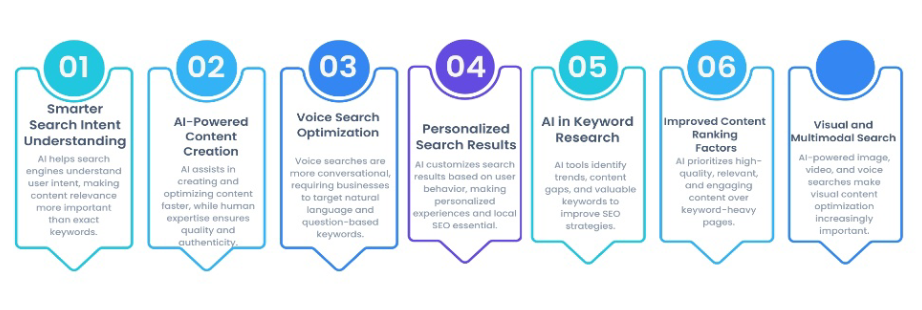
2. AI-Powered Content Creation
AI tools can now:
- Generate blog ideas
- Write drafts
- Optimize headlines
- Suggest keywords
- Improve readability
However, while AI speeds up content creation, human creativity and expertise are still essential to ensure originality and trustworthiness.
3. Voice Search Optimization
With AI assistants like Siri, Alexa, and Google Assistant, voice search is growing rapidly.
Voice searches are:
- Longer
- Conversational
- Question-based
Example:
Instead of “SEO services India”, users ask:
“Which is the best SEO company in India for small businesses?”
Businesses must optimize content for natural language queries.
- Personalized Search Results
AI allows search engines to personalize results based on:
- Location
- Search history
- Device usage
- User preferences
This means two users searching the same keyword may see different results.
To adapt, businesses must focus on user experience (UX) and localized SEO strategies.
5. AI in Keyword Research
Traditional keyword research is now enhanced with AI tools that can:
- Predict trending keywords
- Analyze competition
- Identify long-tail opportunities
- Suggest content gaps
This helps businesses target high-intent, low-competition keywords more effectively.
6. Improved Content Ranking Factors
AI algorithms now evaluate content based on:
- Relevance
- Engagement time
- Content depth
- User satisfaction
This means thin or low-quality content will not rank well anymore, even if it is keyword-optimized.
7. Visual and Multimodal Search
AI has expanded SEO beyond text. Users can now search using:
- Images
- Voice
- Videos
Google Lens and visual search tools are growing rapidly, making image SEO and video SEO more important than ever.
How Businesses Should Adapt to AI-Driven SEO?
To stay competitive, businesses must:
Focus on High-Quality Content
Create valuable, informative, and user-focused content instead of keyword-heavy articles.
Use AI Tools Wisely
Leverage AI for research and optimization but avoid over-reliance on automation.
Optimize for Search Intent
Understand what users want and create content that solves their problems.
Improve Website Experience
Fast loading speed, mobile responsiveness, and clean UI are critical ranking factors.
Invest in Local SEO
AI prioritizes local and personalized results, making local SEO essential.
Future of SEO in the Age of AI
SEO is evolving from a keyword-based strategy to an intelligent, intent-driven ecosystem.
In the future, we can expect:
- More AI-generated search results
- Greater emphasis on user behavior signals
- Hyper-personalized search experiences
- Integration of AI chat-based search engines
Businesses that adapt early will have a significant competitive advantage.
Conclusion
AI is not replacing SEO—it is redefining it. The focus is shifting from keywords to context, from ranking tricks to user experience, and from static content to intelligent, dynamic optimization.
For businesses like Inforow Technologies, embracing AI-powered SEO strategies is the key to staying visible, competitive, and relevant in the digital world.
Google’s official documentation on AI-powered search experiences highlights the importance of people-first, helpful content for better visibility in search results. Click here here for more details.
Contact Inforow Technologies now