

In today’s competitive business environment, organizations need more than standalone software solutions to stay ahead. While Customer Relationship Management (CRM) systems help businesses manage customer interactions and sales processes, Enterprise Resource Planning (ERP) systems streamline operations such as finance, inventory, procurement, and human resources.
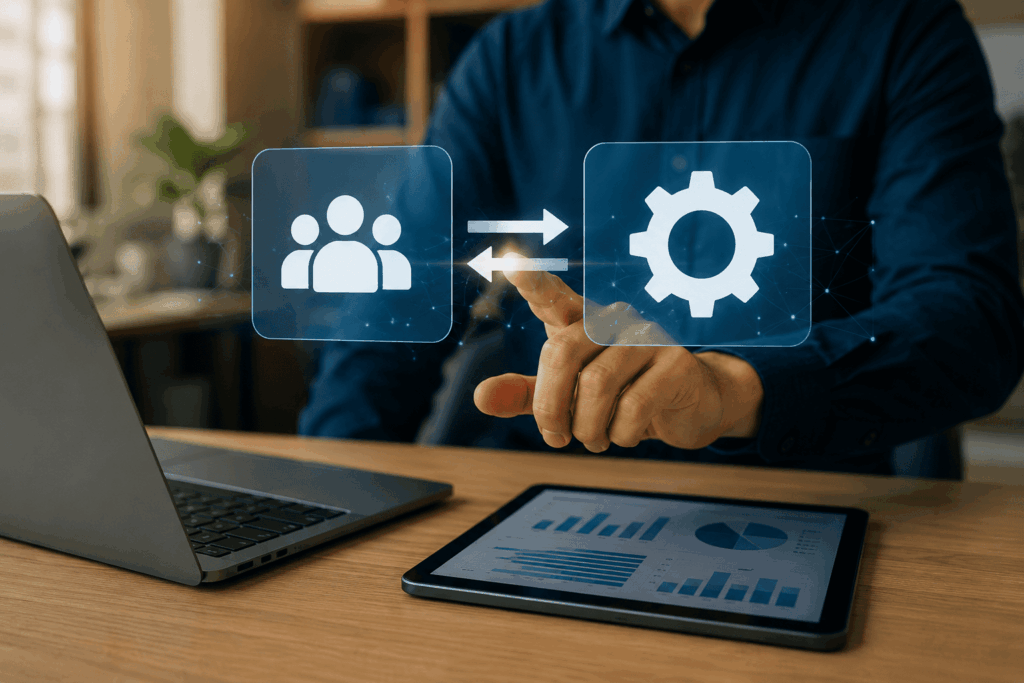
When these two powerful systems work together, businesses gain a unified view of their operations and customers. This is where CRM and ERP Integration becomes a game-changer.
By connecting customer-facing processes with back-office operations, businesses can eliminate data silos, improve decision-making, and create a seamless workflow that supports sustainable growth.
What Is CRM and ERP Integration?
CRM and ERP integration is the process of connecting your CRM software with your ERP system to enable real-time data sharing between departments.
CRM Typically Manages:
- Customer information
- Leads and prospects
- Sales pipelines
- Marketing campaigns
- Customer support interactions
ERP Typically Manages:
- Inventory management
- Accounting and finance
- Supply chain operations
- Procurement
- Human resources
- Production planning
Integration ensures that both systems communicate automatically, eliminating duplicate data entry and ensuring consistency across the organization.
Why Businesses Need CRM and ERP Integration?
As businesses grow, managing customer data and operational processes separately becomes increasingly challenging.
Common problems include:
- Duplicate data entry
- Inconsistent customer records
- Delayed order processing
- Poor visibility into business performance
- Communication gaps between departments
- Increased operational costs
Integrating CRM and ERP systems helps solve these challenges by creating a single source of truth for business data.
Key Benefits of CRM and ERP Integration
1. Improved Data Accuracy
Manual data entry often leads to errors and inconsistencies.
With integration:
- Customer information updates automatically
- Order details sync in real time
- Inventory levels remain accurate
- Financial data stays up to date
This reduces mistakes and improves overall business efficiency.
2. Enhanced Customer Experience
Customers expect quick responses and personalized service.
When CRM and ERP systems are connected:
- Sales teams can access order histories
- Customer service representatives can track shipments
- Support teams can resolve issues faster
This leads to higher customer satisfaction and stronger relationships.
3. Faster Sales Processes
Sales representatives often need information from multiple departments before closing deals.
Integrated systems provide:
- Real-time inventory visibility
- Product availability updates
- Pricing information
- Order status tracking
As a result, sales cycles become shorter and more efficient.
4. Better Inventory Management
Inventory management is critical for operational success.
CRM and ERP integration allows businesses to:
- Monitor stock levels in real time
- Forecast demand accurately
- Prevent stock shortages
- Reduce excess inventory
This helps maintain optimal inventory levels while reducing costs.
5. Increased Productivity
Employees spend less time switching between systems and manually entering data.
Benefits include:
- Automated workflows
- Reduced administrative tasks
- Faster access to information
- Improved collaboration
Teams can focus more on strategic activities rather than repetitive tasks.
6. Real-Time Business Insights
Decision-makers need accurate information to drive growth.
Integrated CRM and ERP systems provide:
- Unified reporting
- Performance dashboards
- Sales forecasts
- Financial analytics
This enables smarter and faster business decisions.
How CRM and ERP Integration Supports Business Growth?
As organizations expand, managing larger customer bases and operational complexities becomes challenging.
Integration Supports Growth by:
Business Area | Impact of Integration |
Sales | Faster deal closures and improved customer tracking |
Marketing | Better customer segmentation and campaign performance |
Customer Service | Faster issue resolution and personalized support |
Finance | Accurate billing and streamlined invoicing |
Inventory | Real-time stock management |
Management | Improved reporting and strategic planning |
By streamlining processes, businesses can scale without significantly increasing operational overhead.
Industries That Benefit from CRM and ERP Integration
Manufacturing
- Production planning
- Supply chain visibility
- Inventory optimization
Retail and E-commerce
- Order management
- Customer purchase tracking
- Inventory synchronization
Healthcare
- Patient management
- Billing processes
- Resource planning
Professional Services
- Project management
- Client relationship tracking
- Financial reporting
Distribution and Logistics
- Shipment tracking
- Warehouse management
- Customer communication
Common Challenges in CRM and ERP Integration
While integration offers significant benefits, businesses may encounter challenges such as:
Data Migration Issues
Moving data from legacy systems requires careful planning to maintain accuracy.
System Compatibility
Not all CRM and ERP platforms integrate seamlessly without customization.
User Adoption
Employees may need training to adapt to new integrated workflows.
Security Concerns
Businesses must ensure secure data exchange and compliance with industry regulations.
Working with experienced technology partners can help overcome these challenges effectively.
Best Practices for Successful CRM and ERP Integration
A] Define Clear Business Goals
Identify the specific objectives you want to achieve through integration.
B] Choose the Right Integration Method
Options include:
- API-based integration
- Middleware solutions
- Custom integrations
- Cloud-based connectors
C] Maintain Data Quality
Clean and standardize data before integration to avoid inconsistencies.
D] Focus on User Training
Ensure employees understand the new processes and system capabilities.
E] Monitor Performance Regularly
Track key performance indicators (KPIs) to measure integration success.
Signs Your Business Needs CRM and ERP Integration
You may benefit from integration if:
- Teams manually enter the same data into multiple systems
- Customer information is inconsistent across departments
- Reporting takes too much time
- Order processing is delayed
- Inventory discrepancies occur frequently
- Departments struggle to share information
If any of these challenges sound familiar, integration may be the next step in your digital transformation journey.
Future Trends in CRM and ERP Integration
Technology continues to evolve rapidly, making integrations more powerful than ever.
Emerging trends include:
- Artificial Intelligence (AI) powered insights
- Predictive analytics
- Cloud-native integration platforms
- Automated workflows
- Real-time business intelligence
- Machine learning-driven forecasting
Businesses that embrace integrated systems will be better positioned to adapt to future market demands.
CRM vs ERP vs Integrated System
Feature | CRM | ERP | Integrated CRM + ERP |
Customer Data | ✔ | Limited | ✔✔ |
Sales Management | ✔ | Limited | ✔✔ |
Inventory Management | ✘ | ✔ | ✔ |
Financial Management | ✘ | ✔ | ✔ |
Real-Time Reporting | Limited | Limited | ✔✔ |
Cross-Department Collaboration | Limited | Limited | ✔✔ |
Scalability | Moderate | Moderate | High |
Why Choose Inforow Technologies for CRM and ERP Integration?
At Inforow Technologies, we help businesses streamline operations through customized CRM and ERP integration solutions.
Our services include:
- CRM implementation
- ERP integration
- Business process automation
- Cloud solutions
- API development
- Data migration
- System customization
- Ongoing support and maintenance
We design scalable solutions that improve efficiency, enhance customer experiences, and support long-term business growth.
Conclusion
CRM and ERP systems are powerful on their own, but their true potential is unlocked when they work together. CRM and ERP Integration enables businesses to connect customer interactions with operational processes, creating a unified ecosystem that improves productivity, enhances decision-making, and drives growth.
As organizations continue their digital transformation journey, integrating these systems is no longer a luxury—it’s a strategic necessity. Businesses that invest in integration today will be better equipped to scale efficiently, improve customer satisfaction, and remain competitive in an increasingly data-driven world.
Partner with Inforow Technologies to build a smarter, more connected business ecosystem and unlock the full potential of your operations.