


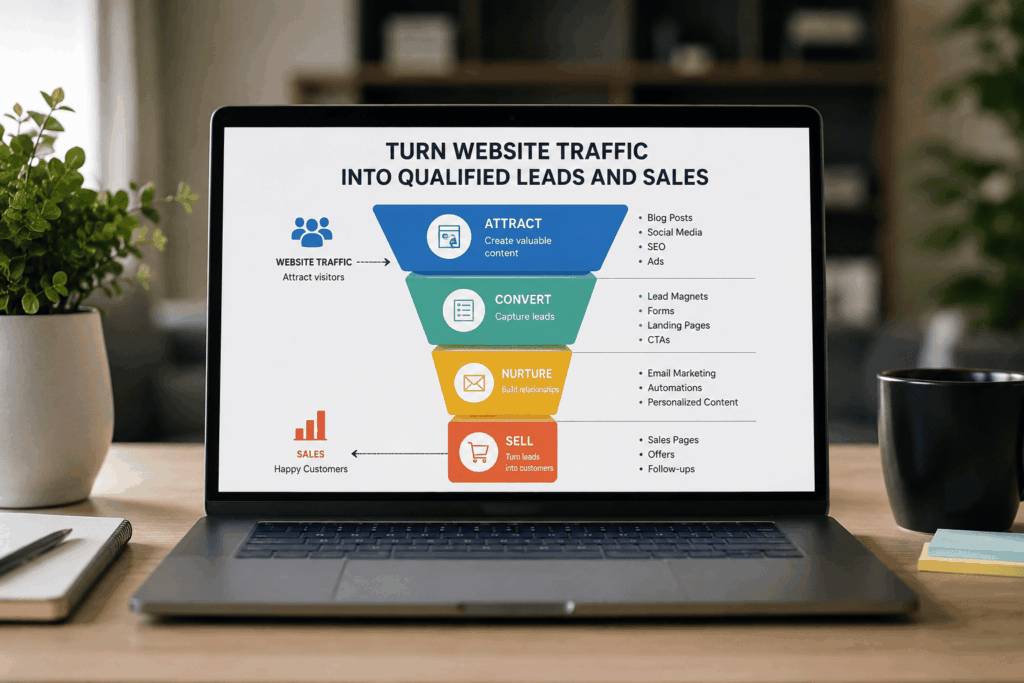
Driving traffic to your website is only half the battle. The real challenge lies in transforming those visitors into qualified leads and ultimately into loyal customers. Many businesses invest heavily in SEO, social media marketing, and paid advertising but struggle to generate meaningful conversions.
At InfoRow Technologies, we help businesses create data-driven digital strategies that not only attract visitors but also convert them into valuable customers through SEO, website optimization, CRM integration, and digital marketing solutions.
In this guide, we’ll explore actionable strategies to turn website traffic into qualified leads and sales.
Why Website Traffic Alone Isn’t Enough?
A website with thousands of monthly visitors may still fail to generate revenue if those visitors aren’t taking action. The goal isn’t simply attracting more traffic—it’s attracting the right audience and guiding them through a conversion journey.
Common reasons websites fail to convert visitors include:
- Poor user experience
- Slow page load speeds
- Weak calls-to-action (CTAs)
- Unclear value propositions
- Lack of trust signals
- Poor lead nurturing processes
The key is creating a seamless path from visitor to customer.
1. Attract the Right Audience with SEO
Not all traffic is equal. Qualified traffic comes from users actively searching for solutions your business offers.
A] Focus on Search Intent
Target keywords based on user intent:
- Informational: “How to improve website conversions”
- Commercial: “Best CRM software for small business”
- Transactional: “Hire digital marketing agency”
B] Create High-Quality Content
Develop content that answers customer questions and solves real problems:
- Blog posts
- Case studies
- Industry reports
- How-to guides
- Videos
C] Optimize for Local SEO
If your business serves a specific location:
- Optimize your Google Business Profile
- Target local keywords
- Build local citations
- Collect customer reviews
SEO-driven traffic often delivers higher conversion rates because users are already looking for solutions. Comprehensive SEO services are a core component of successful digital marketing strategies.
2. Improve Website User Experience (UX)
Visitors decide within seconds whether to stay on your website.
Essential UX Improvements
A] Fast Loading Speed
- A slow website increases bounce rates and reduces conversions.
B] Mobile Responsiveness
- With most users browsing on mobile devices, your website must perform flawlessly across all screen sizes.
C] Clear Navigation
Help visitors find information quickly with:
- Simple menus
- Logical page structure
- Search functionality
D] Trust-Building Design
Use:
- Professional layouts
- Customer testimonials
- Security badges
- Certifications
- Client logos
A user-friendly website builds credibility and encourages visitors to take action.
3. Create High-Converting Landing Pages
Landing pages play a critical role in lead generation.
Elements of an Effective Landing Page:
1] Compelling Headline
- Clearly communicate the benefit:
Example:
“Increase Your Qualified Leads by 50% with Data-Driven Digital Marketing”
2] Strong Value Proposition
- Explain why visitors should choose your business.
3] Benefit-Focused Copy
- Focus on outcomes rather than features.
4] Conversion-Focused CTA
Examples:
- Get a Free Consultation
- Download the Guide
- Request a Demo
- Schedule a Call
5] Social Proof
Include:
- Testimonials
- Reviews
- Success stories
- Case studies
4. Use Lead Magnets to Capture Visitor Information
Most visitors won’t buy during their first visit.
Lead magnets encourage visitors to exchange their contact information for valuable resources.
Popular Lead Magnets
- Free eBooks
- Industry reports
- Templates
- Checklists
- Webinars
- Free audits
- Consultation calls
For example, a digital marketing agency might offer:
“Free SEO Audit: Discover What’s Holding Your Website Back from Ranking Higher.”
This helps generate qualified leads while providing immediate value.
5. Implement Smart Calls-to-Action (CTAs)
A strong CTA guides visitors toward the next step.
Best Practices:
- Use action-oriented language
- Create urgency when appropriate
- Make buttons visually prominent
- Place CTAs strategically throughout pages
Examples:
- Get My Free Audit
- Book a Strategy Session
- Request a Custom Quote
- Start Growing Today
Avoid generic CTAs like:
- Click Here
- Submit
6. Use Marketing Automation and CRM Systems
Capturing leads is only the beginning.
Businesses need systems to nurture leads until they’re ready to buy.
Benefits of CRM Integration:
- Track customer interactions
- Segment audiences
- Automate follow-ups
- Monitor sales pipelines
- Improve conversion rates
CRM and automation solutions help businesses manage leads more efficiently and improve sales performance.
7. Nurture Leads with Email Marketing
Most leads require multiple touchpoints before making a purchase decision.
Effective Email Sequences
A] Welcome Email:- Introduce your business and value proposition.
B] Educational Content:- Provide insights and solutions.
C] Case Studies:- Show real-world success stories.
D] Special Offers:- Encourage action with limited-time opportunities.
Consistent email nurturing builds trust and keeps your brand top-of-mind.
8. Retarget Visitors Who Didn’t Convert
Only a small percentage of visitors convert on their first visit.
Retargeting allows you to reconnect with users who previously visited your website.
A] Retargeting Channels
- Google Ads
- Facebook Ads
- Instagram Ads
- LinkedIn Ads
B] Retargeting Campaign Examples
- Downloaded a guide, but didn’t book a consultation
- Visited the pricing page, but didn’t contact sales
- Added products to the cart, but didn’t purchase
Retargeting often generates some of the highest ROI in digital marketing.
9. Leverage Social Proof and Trust Signals
People trust businesses that others recommend.
Trust-Building Elements
- Customer reviews
- Video testimonials
- Case studies
- Industry certifications
- Client success metrics
Example:
“Our SEO and lead generation strategy helped a client increase qualified leads by 40% within three months.” Trust signals reduce friction and increase conversion rates.
10. Continuously Measure and Optimize
Conversion optimization is an ongoing process.
Key Metrics to Track:
- Traffic sources
- Bounce rate
- Conversion rate
- Cost per lead
- Lead-to-customer rate
- Customer acquisition cost (CAC)
Tools to Use
- Google Analytics
- Google Search Console
- CRM dashboards
- Heatmap tools
- A/B testing platforms
Regular analysis helps identify bottlenecks and improve performance over time.
The Website Visitor-to-Customer Growth Process
A successful conversion strategy follows this path:
Step 1: Attract the Right Audience
The journey begins with bringing qualified visitors to your website through targeted digital marketing efforts.
Channels:
- Search Engine Optimization (SEO)
- Content Marketing
- Social Media Marketing
- Pay-Per-Click (PPC) Advertising
- Referral & Partner Marketing
Goal: Increase high-intent traffic from users actively looking for your products or services.
Step 2: Capture Visitor Information
Once visitors arrive, the next objective is to convert them into leads by offering value and encouraging engagement.
Lead Generation Assets:
- Conversion-Focused Landing Pages
- Contact Forms
- Free Consultations
- Downloadable Resources (eBooks, Guides, Checklists)
- Newsletter Sign-Ups
Goal: Turn anonymous visitors into identifiable prospects
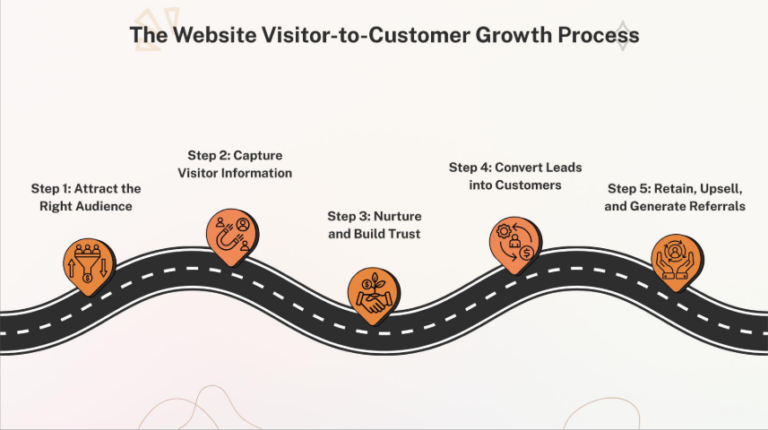
Step 3: Nurture and Build Trust
Most prospects are not ready to buy immediately. Effective lead nurturing helps educate, engage, and build credibility over time.
Nurturing Strategies:
- Email Marketing Campaigns
- CRM Automation
- Personalized Content
- Retargeting Ads
- Case Studies & Success Stories
Goal: Move leads closer to a purchasing decision.
Step 4: Convert Leads into Customers
With the right messaging and timely engagement, qualified leads are guided toward making a purchase decision.
Conversion Activities:
- Product Demonstrations
- Discovery Calls
- Consultations
- Custom Proposals
- Sales Follow-Ups
Goal: Transform qualified leads into paying customers.
Step 5: Retain, Upsell, and Generate Referrals
The customer journey doesn’t end after the sale. Long-term growth comes from customer retention and advocacy.
Retention Tactics:
- Ongoing Customer Support
- Loyalty Programs
- Upselling & Cross-Selling
- Customer Success Initiatives
- Referral Programs
Goal: Increase customer lifetime value and generate new business through referrals.
The Growth Formula
Attract → Capture → Nurture → Convert → Retain
This proven framework creates a sustainable revenue engine that consistently turns website traffic into qualified leads, customers, and long-term brand advocates.
Final Thoughts
Generating website traffic is important, but turning that traffic into qualified leads and sales is what drives real business growth. By combining SEO, conversion-focused design, lead generation strategies, CRM automation, and continuous optimization, businesses can significantly improve their return on digital marketing investments.
At InfoRow Technologies, we specialize in helping businesses attract the right audience, optimize their websites for conversions, and implement digital marketing strategies that deliver measurable results. Our expertise spans SEO, website development, CRM solutions, analytics, and performance-driven digital marketing.
Ready to turn your website visitors into customers? Contact InfoRow Technologies today and start building a conversion-focused digital growth strategy.